
We print a lot of hardware and khaki on our punk line, and dieselpunk is where that impulse comes from honestly, so it is a look we have cut into and worn on festival fields long enough to have opinions about how it goes wrong.
Is dieselpunk just steampunk's younger sibling?
No, and the gap between them is the whole point. Steampunk lives in the Victorian and Edwardian 19th century, running on brass, clockwork and gearing, and its mood stays romantic and adventurous. Dieselpunk runs on combustion, industrial machinery and the diesel engine, and it sits later, roughly from the First World War through to the 1950s, with the interwar years of 1918 to 1939 as its centre of gravity. The term itself is young. Game designer Lewis Pollak coined it in 2001 for his tabletop RPG Children of the Sun.
The hinge is the First World War. That is the moment the mood turns dark. Steampunk imagines a future out of Victorian optimism, when the machine still felt like pure progress. Dieselpunk imagines a future out of the trenches, when the machine had just been used to kill people at industrial scale for four years. So where steampunk reaches for brass and top hats and Verne, dieselpunk reaches for Art Deco, film noir shadow, aerodynamic streamlining and military hardware. The two are both retrofuturist aesthetics, both futures built from an older technology, but they are not the same era and they do not carry the same feeling. If a look is optimistic and gleaming, it is probably not diesel.
The visual influences that keep recurring are Art Deco, Streamline Moderne, film noir, Constructivism and Bauhaus, with jazz and big-band culture underneath. The genre even has its own portmanteau for the brighter register, decodence, Art Deco crossed with decadence.
What are the two dieselpunks?
There are two recognised strands, and they pull in opposite emotional directions. The first is the bright one, the what-if where the Roaring Twenties never crashed. No Depression, no war, just streamlined Art Deco progress carrying on forever, all clean lines and confidence. The second is the grim one, sometimes called the Piecraftian strand, built on perpetual warfare, totalitarian control and post-apocalyptic overtones. That darker version is closer to what actually happened in the 1930s and 40s, which is why it tends to feel more grounded.
You can see both in the films. Metropolis from 1927 gives you the industrial Art Deco imagery at the source. The Rocketeer from 1991 is the pulp-aviation adventure end, lighter and heroic. Sky Captain and the World of Tomorrow from 2004 is the fullest single reference, an alternate 1930s built around Art Deco design, diesel aircraft and zeppelins, shot in a sepia palette, with the director naming 1930s industrial designer Norman Bel Geddes and period pulp comics as his sources. Iron Sky from 2012 sits at the darker, more openly totalitarian end. In games, BioShock and Command and Conquer: Red Alert both carry the Art Deco retrofuturist design language.
The thematic material tells you which way a piece leans before you see a single garment: espionage, resistance, totalitarianism, and a running anxiety about what industrial acceleration does to people.
Why is a boiler suit as dieselpunk as a zoot suit?
Because the class axis is built into the aesthetic, and it runs the full width. Dieselpunk fashion is explicitly described as spanning from the posh zoot suit to the humble working-class overall, and both ends are correct. This is not a look that picks a wardrobe and stops. It picks a period and lets the whole society of that period show up.
At the formal end you get the 1930s and 40s tailored suit, fitted through the body, wide lapels, single or double breasted, with shoulder padding doing real work. Pinstripe suiting. The waistcoat. The zoot suit at the top of the spectrum, oversized and theatrical. A fedora or a panama over the top. At the other end you get overalls and coveralls, cargo-cut trousers, the durable workwear that the actual working population wore to actual work. In between sits the military and aviation strand, which is where a lot of the drama lives: leather trench coats, aviator and bomber jackets, field jackets, flight goggles, heavy boots.
For the womenswear the reference is wartime pin-up and film-noir styling. Fitted, often shorter-skirted dresses, peplums, shoulder pads applied even to simple silhouettes, the draping techniques that ran through 40s noir-adjacent fashion. Navy, red, black, green and white recur, with military-green and navy-and-white sailor motifs echoing service dress directly.
The reason we keep coming back to this axis is that it maps onto how we cut our own punk flavour, strong hard lines at one end and utility layering at the other. A tailored waistcoat and a boiler suit are not a contradiction here. They are two honest readings of the same decade.
Why does real field kit beat a costume version of it?
Because the fabric was built for the job, and you can feel the difference the moment you put it on. The single most practical route into the aviation and military strand is genuine or reproduction military surplus: field jackets, bomber jackets, flight jackets. Surplus is cited again and again as the cost-effective way in, and the reason is not price alone. Surplus pieces are cut from the heavier, weather-resistant cotton, cotton blend and canvas the era actually used, fabric made to resist wind, rain, mud and abrasion. A costume approximation uses lighter civilian cloth and looks like fancy dress the second it moves.
We have watched this play out on festival fields for years. The person in a real field jacket looks right at four in the morning in a downpour because the jacket was designed for exactly that. The person in a thin repro version is cold and shiny and reads as a party outfit. The cloth is the tell.
The formal end works differently. The suiting, the waistcoats, the pinstripe come from vintage-reproduction menswear and thrifted 1930s-40s silhouettes rather than surplus stores. The pin-up and noir womenswear comes from dedicated vintage and reproduction 40s lines and thrifted period dresses. Surplus is the shortcut for the military strand specifically, not for the whole look.
What is the palette, and where does the red go?
Muted and earthy, with one narrow exception. Khaki, olive, brown, black and grey dominate the whole aesthetic, and they dominate for a reason: this is the palette of uniform, engine grease, weathered leather and wool. The occasional pop of bright red or blue exists, but it belongs to the pin-up and noir strand, not the military one. That is the one place the red goes. Put a bright red on a field jacket build and you have broken the logic. Put it on a 40s dress and it is period-correct.
The cloth carries the same divide. Wool, tweed and corduroy do the suiting. Leather does the coats and jackets. Canvas does the military and workwear and the bags. The heavier cotton and cotton-synthetic blends belong to the genuine surplus. Metal and glass turn up in the jewellery and eyewear. The material logic across the whole thing favours durability and function on the military and workwear side, blended with proper tailoring cloth on the formal side, which is the posh-and-working-class spread showing up one more time, now in the fabric itself.
We work a lot in natural, heavier registers on our raw organic and punk flavours, so the diesel palette sits close to how we already think. Olive, black, worn leather tones and strong prints over hard cuts. The discipline is in the restraint. The colour does most of its work by staying quiet.
What do we cut that lives next door to this?
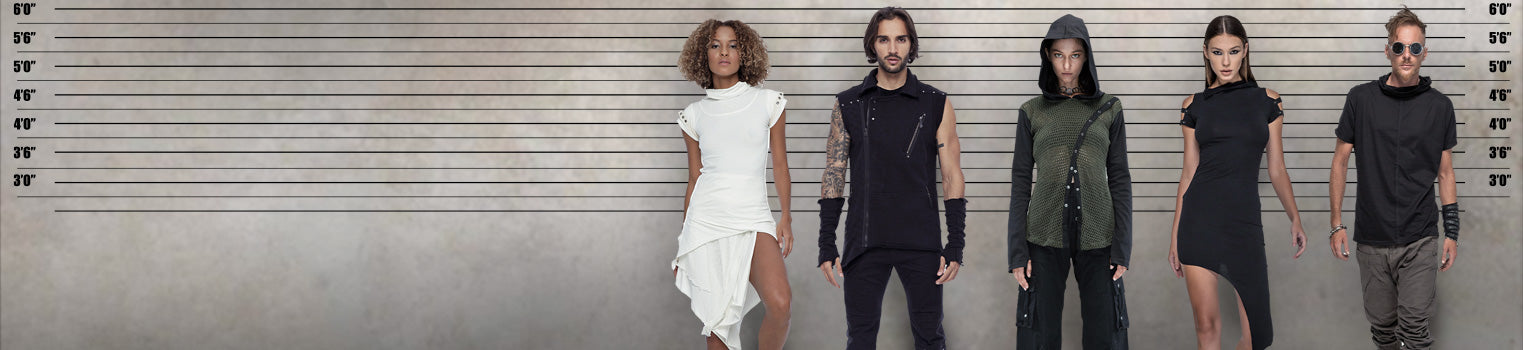
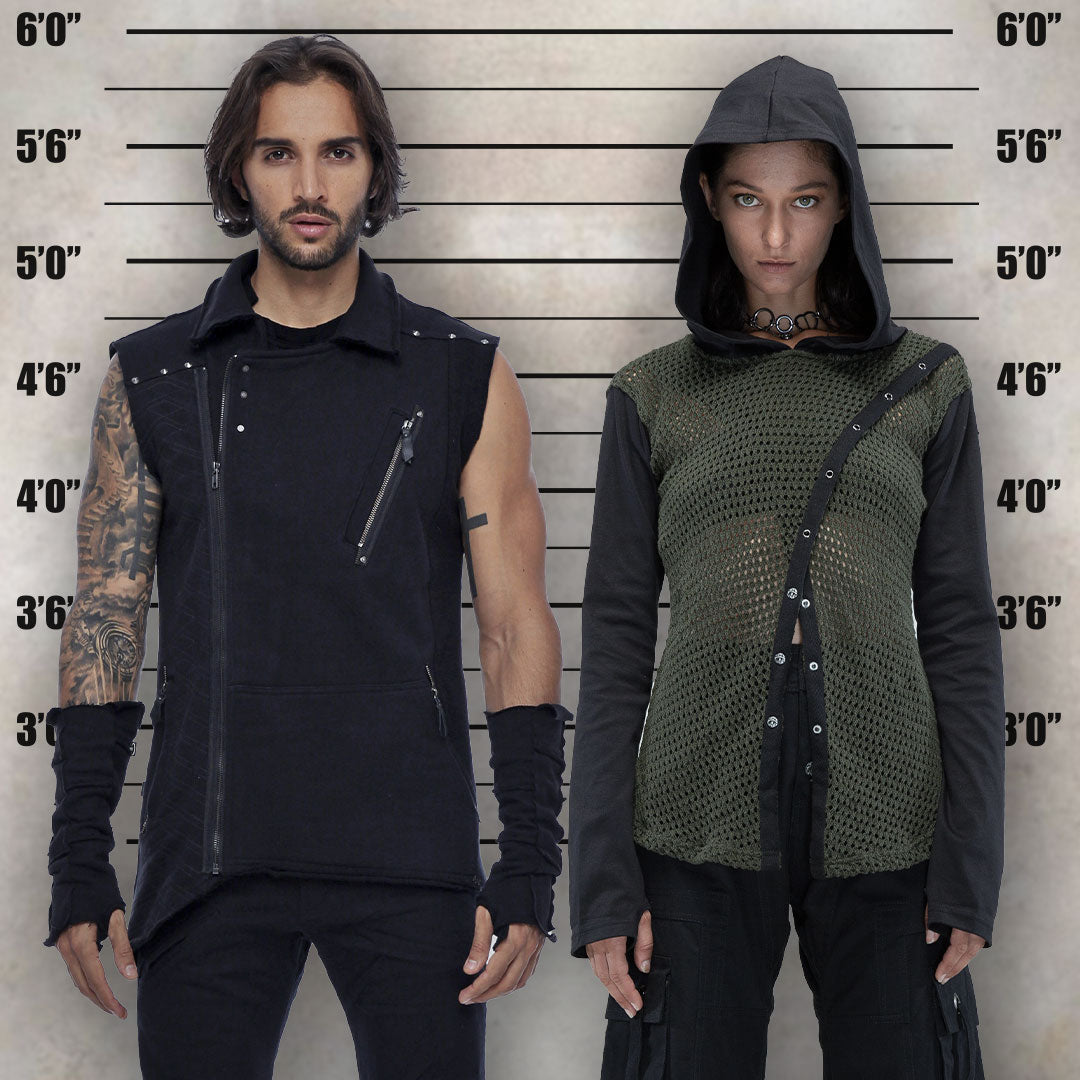
Our punk flavour is the nearest neighbour. Strong and hard cuts, all-black, distressed and layered, utility construction, a register we already reach for when we print hardware-heavy graphics and cut structured, sharp-shouldered lines. None of that is dieselpunk by name, but it shares the same bones: the utility layer, the hard silhouette, the muted palette, the sense that a garment should look like it does a job.
Where the two genuinely overlap is utility and structure. A hard-cut jacket, layered over a heavier base, in olive or black, reads straight into the military strand without any period costuming at all. Add a real field-weight fabric and it stops being a nod and starts being the thing. Our ethno flavour drifts further away, since draping and warm print pull toward a different century, and raw organic is quieter than diesel ever is. But the punk end is close enough that a lot of a dieselpunk military build can be assembled from clothing that was never labelled dieselpunk in the first place. That is usually the strongest version anyway, real cloth doing real work rather than a themed outfit announcing itself.
A wristwatch, or the whole build?
You get to choose your point on the spectrum, and the aesthetic is built to let you. Dieselpunk does not require a full costume. Its own reference material says so plainly: a single vintage-coded accessory can be enough to signal the look. A vintage wristwatch, a pair of Art Deco earrings, an old petrol lighter of the Zippo kind, any one of these is named as a sufficient minimal entry point. That is the wristwatch end, the aesthetic worn as a detail over otherwise contemporary clothing.
One step up, you add a single strong silhouette over modern clothes: a fedora, a trench coat, or a fitted waistcoat carrying the period line on its own. Then comes the full build, where you commit to a strand and dress it end to end, whether that is a period-tailored formal ensemble, a surplus-sourced military kit, or a 40s pin-up and noir wardrobe, and where mixing formal suiting with utilitarian surplus is treated as normal rather than a clash.
The honest way to think about it is a dial rather than a rulebook. The two contested end-dates, the two emotional strands, the class axis from zoot suit to boiler suit, all of it means there is no single official version to get right. You pick the darkness, you pick the class register, you pick how far down the dial you want to go, and then you make the cloth tell the truth. A watch on the wrist is a real point on that dial. So is a full field jacket build in the rain. Both are dieselpunk, and the whole aesthetic exists precisely to let you stand anywhere between them.