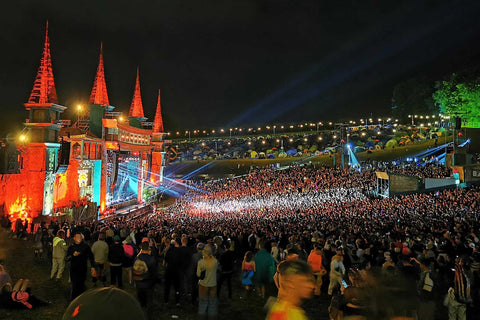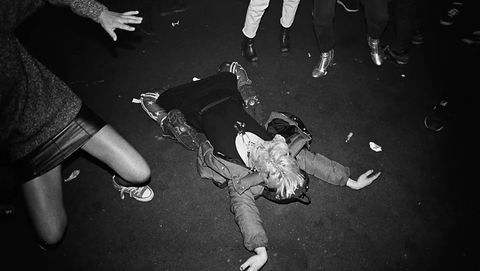

On 5 July 1969, somewhere between a quarter and half a million people lay on the grass in Hyde Park to watch the Rolling Stones play for free. Mick Jagger read Shelley for a dead bandmate, the Hells Angels were minding the stage, and the weak English sun did what it could. Nobody had charged a penny. What the afternoon proved was simpler and more lasting than the music: a city park could hold half a million people who wanted nothing more than to be outside, together, in front of a band.
England did not inherit its place as the summer stage of live music. It built it, gig by gig and field by field, mostly by accident, and London built it faster than anywhere else. The reason the British summer is now spent watching music outdoors runs through a handful of parks and one short, unreliable season. It is worth knowing before you buy a ticket to any of it.
We have watched it from the same corner of Camden for years. None of what follows is a neutral history for us. It is our season, and these are, more or less, our parks.
Before the fences

It was not only Hyde Park, and not only the daylight. The north of the city had its own rooms, and the underground filled them. In 1967 the Great Hall of Alexandra Palace and a cinema on Seven Sisters Road each had a night that outlived everyone in it, and the alternative, psychedelic London they belonged to is the one Psylo grew out of. The city was learning it could gather in its tens of thousands, by day or long after dark.
While London was proving that a city park could be a venue, the rest of the country was inventing the festival. The Isle of Wight ran three of them between 1968 and 1970, and the last, in August 1970, brought somewhere between 600,000 and 700,000 people to a field to see Jimi Hendrix give what turned out to be his final UK performance. It was Britain's answer to Woodstock, and it alarmed Parliament enough to effectively legislate it off the island. Hendrix died weeks later. The morning after his death, on a dairy farm in Somerset, a man called Michael Eavis charged 1,500 people a pound each, a free pint of milk included, for the first Glastonbury. He had seen Led Zeppelin at the Bath festival and thought he could do a version on his own land. The Pyramid stage went up the following year.
That is the inheritance: the free park concert and the muddy field, the city and the farm, arriving at the same idea within a year of each other.
The short season
There is a plain reason all of this happens between May and August, and it is the weather. The British summer is brief, unreliable and therefore precious. You cannot bank on it, so when it arrives the whole country goes outside at once and refuses to come back in. A festival here is half a music event and half a national decision to ignore the forecast.
London had the rest of the ingredients. A population dense enough to fill a park on a weeknight. A live industry with deep roots and deeper pockets. And, above all, large public parks held in common, green spaces a short bus ride from the centre and big enough to drop a stage into. Victoria Park in the east, Brockwell in the south, Finsbury and Alexandra Palace in the north, Hyde Park in the middle. The commons became the venues.
The circuit

Victoria Park / Copyright: Archant
It is no longer free, and it is no longer simple. Every summer the councils field the noise complaints and the residents' associations and the old question of who a public park is actually for. Last year a campaigner took Lambeth Council to the High Court over the way Brockwell Park was being handed to festival organisers, and won, before the council approved the programme again regardless. The tension is permanent. A city this size needs somewhere to come together in the open, and the ground it stands on pays for the privilege.
The stages, from here to the end of summer
It is the middle of June, and the first half of the season is already packed away. South London had its weekend over the late May bank holiday and the fences there are long down. What is left of the summer belongs to a few places, each with its own history and its own crowd.
Hyde Park. The royal park in the centre is the oldest and biggest stage of them all, and the most mainstream: less a festival than a run of stadium nights laid out on a lawn. This year British Summer Time fills its weekends from 20 June to 16 July. Garth Brooks plays 27 June, his first UK show in nearly thirty years; ATEEZ the 28th; Maroon 5 with OneRepublic on 3 July; Pitbull and Kesha on the 10th; Lewis Capaldi closes two nights on the 11th and 12th; and Mumford & Sons come home to West London. The free Open House programme fills the midweek gaps with screenings and smaller sets.

Finsbury Park. Finsbury earned its place in this story before it ever held a festival. On its edge, on Seven Sisters Road, stood the Finsbury Park Astoria, a 1930 cinema that doubled as a concert hall and later became the Rainbow Theatre. It was there, on 31 March 1967, that Jimi Hendrix first set fire to a guitar on stage, three months before he did the same at Monterey and made the picture famous. The park itself became an open-air concert ground in the 1990s, and from 2014 it was the long-standing home of Wireless, the country's biggest rap and hip-hop festival, until this year's edition was called off after its headliner was refused entry to the country. In its place the park takes a weekend of rock over the first weekend of July: Biffy Clyro on the 3rd, Kasabian on the 4th, Wolf Alice on the 5th, with dance and electronic nights into early August.
Beyond the parks, the fields.
We watch all of it from the same corner of Camden, where the tribe assembles in May with the season ahead of it and drifts back in September with the season on its boots. We do not sell the festival. We dress the people walking into it, and we see what comes back, sun-bleached, rained on, kept. The fences will come down. The grass at Brockwell will be roped off and reseeded, the worn paths through Victoria Park will close over, and by October you would not know the stages had stood there at all. Then the flatbeds arrive again, and the city does the whole thing once more.