We have kitted the British field out from Camden since 2007, and here is what it taught us.
We started making in Bali in 1999 and opened the Camden flagship in the Stables in 2007, which means we have watched the same customers walk out of the shop in June and reappear in photographs a fortnight later, coated to the knee in Hampshire clay. The British festival is where a good print gets tested against real conditions, and where we learned that the clothes worn on these fields are answering a question about weather before they answer anything about taste. That is the honest reason this subject is ours to write. Below is how the independent end of the circuit actually differs festival to festival, and what the shared sky underneath all of it demands you wear.
Where does the "independent" festival circuit actually begin, and why the asterisk?
The independent end of the map is the cluster of festivals founded by people who came up through the free-party and sound-system scene, built on stated no-corporate-sponsorship policies, and run at a human scale rather than an arena-tour one. But "independent" now needs an asterisk, and it is worth knowing before you use the word.
Boomtown is the clearest case. Founded in 2009 by Chris Rutherford and Luke Mitchell, both of whom came up through the festival and free-party world, it was built because mainstream festivals "lacked atmosphere" and ignored whole genres. It settled at the Matterley Estate near Winchester from 2011. It is also no longer fully founder-owned: Live Nation UK took an 18% stake in 2022 after pandemic-era financial strain. Bearded Theory sits in the same grey area. Nottingham promoter DHP Family, which calls itself one of the last fully independent national promoters in the UK, bought a stake in 2022 in partnership with founders Richard Bryan and Stephen Blount, who still run delivery.
So the truly sponsorship-free holdouts are the ones to name plainly. Beautiful Days, run by the band the Levellers since 2003 at Escot Park in Devon, takes zero corporate branding by explicit policy. Frontman Mark Chadwick put the reasoning bluntly: "as soon as the corporate hand sticks its tiniest bit in, they're fucked." Shambala, founded in 2000 by friends who ran the Jibbering Records shop before the festival, is 100% sponsorship-free and in 2026 converted to a worker-owned trust, which it describes as the first worker-owned festival in the UK. When we cut a run for these crowds, we are cutting for people who chose their weekend on that basis, and they notice everything.
What actually sets Boomtown, Shambala, Beautiful Days, Bearded Theory and Wilderness apart?
Five festivals, five different worlds, and the differences are structural rather than a matter of lineup. Read them by what they are built to do.
Boomtown is not a field with stages. It is a fictional city across 1,250 acres, split into eight themed districts with street-level set design, over 50 hidden venues run by independent collectives and record labels, a mock post office and police station, an in-universe newspaper called The Daily Rag and a running mayoral storyline. The music is deliberately scattered by founding intent across folk, gypsy, reggae, punk, pirate, jazz, jungle, techno, drum and bass and ska, spread through the districts rather than stacked onto headline slots. It runs the second week of August at an established capacity near 66,000, recently expanded toward 77,000.
Shambala, in Northamptonshire, often at Kelmarsh Hall, keeps its exact site secret until you buy a ticket. Around 15,000 a day, four days in late August, no cars on site and biofuel shuttles, with a music programme of rock, pop, folk and world music sitting alongside film, comedy, workshops and site-wide art. Beautiful Days, at Escot Park in Devon in August, capacity 17,500, is the Levellers' festival and programmes rock, folk, punk, dance and experimental, and pointedly books international acts a UK crowd will not know, from Mali, Norway, Bosnia and beyond. Bearded Theory, at Catton Park in South Derbyshire since 2014, is the outlier by calendar, running in May, and is the family engine of the circuit, with an award-winning Children's Village and a "Festival School," across punk, indie, folk, world, reggae and dance on nine stages, having hosted Robert Plant, Patti Smith and Iggy Pop.
Wilderness, at Cornbury Park in Oxfordshire over four days in late July, is the odd one out. It is Music plus Arts plus Food plus Wellbeing rather than a scene, with forest banquets, yoga, literature talks and collaborations with the Royal Academy and the Southbank Centre. The music is headline-driven and eclectic, spanning indie, dance and electronic, with the odd bespoke orchestral piece. Treat its size as boutique to mid-scale rather than a precise figure, because the reported numbers do not agree.
Where is the costume real, and where does the field just want band tees and boots?
The honest answer is that costume is a genuine, defining feature at only two of these, and the rest run on practical outdoor kit. Knowing which is which saves you from turning up over-dressed to a field that wanted boots.
Boomtown is where the costume is fully real. The entire fictional-city design exists to pull character play out of you. The crowd runs from teenagers to older hippies to what its own materials call "outlandish family groups," dressing in and out of character to the district they are standing in. This is the one place on the circuit where strong cuts, utility layers and post-apocalyptic flair are the point rather than an affectation, because everyone around you is building a character too. Shambala carries a different, softer version: theme-driven fancy dress tied to the year's announced theme, culminating in a Sunday samba procession. It is dressing to a brief, not roleplay.
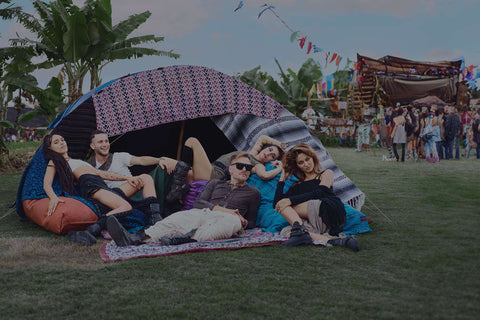
Beautiful Days, Bearded Theory and Wilderness are the band-tee-and-boots end. The sourced record shows conventional festival-goer dress at all three, which is to say practical outdoor wear that has to survive a Devon or Derbyshire field. When we print for these weekends we lean on what the fabric and cut can take standing in a queue at midnight, not on how it reads in a costume parade. A black tee that has been through the wash a hundred times, a layer that packs down small, a print that does not care about mud. That is the assignment for three festivals out of five, and it is worth respecting.
What is Glastonbury's "naughty corner," and where does its free-festival root live?
Glastonbury's counterculture root survives in a specific set of late-night areas that were built deliberately to hold the line against the festival's own scale. Michael Eavis founded Glastonbury in 1970 at Worthy Farm, and it now runs in June across five days at a capacity near 210,000, so calling any of it "alternative" needs a place to point at. These areas are that place.
The naughty corner began with Lost Vagueness, a bar Roy Gurvitz set up in the travellers' field that mutated into an ironic, twisted mini-town, which Eavis let keep evolving. It is now a cluster of themed late-night districts. Shangri-La tracks the zeitgeist year to year through satirical outsider art. Block9 is built around large set-pieces, its best known a decaying tower block with a full-size London Underground train bursting out of the top, and it showcases London's underground sound-system scene. Arcadia is what the festival calls "a robotic rave from outer space," dance music staged around huge mechanical sculptures. The Glade, an open-air stage running since 2000, connects back to the standalone Glade Festival lineage.
Further out, the Green Fields hold the most direct throughline to the 1970s hippie and free-festival roots: Green Futures, the Stone Circle, the Healing Field. The Left Field is run by a cooperative and oriented toward campaigning and political culture. If you want to understand why the giant kept these corners alive, stand in the Green Fields at dawn, then walk into Block9 after midnight. Same festival, thirty years of counterculture holding its ground inside it.
The layering system that outlives the weekend
Here is the part every one of these festivals shares, whatever the music. The British field is a physics problem, and the physics do not care which stage you are stood at.
Southern England in summer runs 18 to 25 degrees by day, which is mild rather than hot. The trouble is the night. July lows sit around 11 degrees nationally, closer to 14 in London, which means a warm afternoon drops into jacket territory the moment the sun goes. Rain is worse than the cold because it is unpredictable, arriving as sudden hard thundershowers rather than forecastable fronts. Glastonbury's own history is the record of how bad this gets: 1997 was "the year of the mud" after the Other Stage began sinking, 2005 saw two months' rain fall in hours and people moving about in dinghies, 2007 was the wettest on record with 60.1mm on the Friday alone, and Eavis called 2016 worse than 1997.
The single most useful thing we know, from years of watching customers come back muddy, is that cotton is the enemy once it is wet. Wet cotton loses up to about 90% of its insulating value and pulls heat off the body many times faster than dry cotton, and once it is soaked, from rain or sweat, it stays a cold clammy second skin for hours. That is the technical basis for the phrase "cotton kills," and hypothermia is a real risk well above freezing once wind and wet combine. Wool and synthetics behave differently: they keep insulating while damp because they do not drink water into the fibre the same way. This is not a comfort preference. It is the reason a base layer that is not pure cotton, and outerwear that is genuinely waterproof, are functional kit at a British festival.
So the system, base layer, mid layer, outer layer, is what actually gets you through, because the same day moves from direct sun to standing-around-cold. A base you can dance in and that does not turn cold when it is wet through. A mid layer that packs down to nothing in a bag between stages. A waterproof outer that earns its space, and boots rather than trainers, because the Glastonbury mud years are the standing proof that these fields become genuine marshland underfoot. Build the outfit as three things that work together and it survives Friday to Monday. Build it as one nice look and the weather takes it apart by the first wet night, which on this circuit is most of them.