

What we have watched survive a weekend, and what we have watched fall apart, learned across twenty-six years of kitting out the field.
We have been making clothes for festival fields since 1999, back when the first things we cut got sold off a stall in the mud, long before there was a shop in Camden or anywhere else. That is the whole reason we can write this. Not because we have opinions about outfits, but because we have watched the same garment leave a field intact one year and come apart the next, and we have spent a long time working out why. What follows is what actually survives a weekend, and what quietly does not, from the people who make the strong cuts and the draped layers you see holding up at four in the morning when the sky starts going pale.
Why does one weekend feel like four different climates?
Because it is four different climates, and your kit has to absorb all of them without you changing more than a layer. One outdoor event, start to finish, can swing further than most people plan for. The Met Office logged Glastonbury's recorded extremes at 4.2°C on the coldest night and 31.2°C on the hottest day, with gusts up to 41mph. That is not a freak spread across a decade to shrug at. That is the range a single garment has to sit inside, because the day-to-night drop happens every night, everywhere outdoors, even in a warm summer.
The desert does it harder and faster. Burning Man attendees are told to expect a swing of roughly 40°F or more between day and night, every day of the event, with hot windy afternoons giving way to genuinely cold nights. Not a surprise, the norm.
The answer is not one perfect garment. It is layering, and it is old and boring and it works. A base layer to move sweat off the skin, a mid layer to hold warm air, an outer shell to break wind and rain. We build the mid layer as the one you actually want to wear all weekend, the draped long-sleeve or the layered top that reads right at midnight and pulls off at noon. The mistake is treating the outfit as a daytime decision. It is a twenty-four-hour decision, and the cold hours are the ones people forget until they are shivering through them.
Which fibre should you actually wear at a festival?
None of them wins, and anyone who tells you one fibre is simply the right answer is selling you something. What matters far more than the label sewn in the collar is how the thing is built. So before the fibre argument, the construction one.
Sun protection is a weave-density question more than a fibre question. If you can see through the fabric, it is not protecting you, whatever it is made of. Tightly woven cloth blocks more UV than loose or sheer cloth, and dark colours block more than pale ones, which is a real trade against the fact that dark fabric soaks up more heat in direct sun. UPF ratings tell you the fraction blocked: UPF 30 stops about 96.7%, UPF 50+ about 98%.
Now the fibre answer nobody wants to hear, and here is where natural quietly loses ground. Cotton is comfortable and cheap, and it is hydrophilic, meaning it drinks moisture and holds it against your skin rather than moving it away, and it dries slowly. One peer-reviewed measurement put polyester's drying rate at roughly 0.30 to 0.35 grams an hour against cotton's roughly 0.13. That gap is the whole problem in wet or cold conditions, because moisture sitting against skin is the mechanism behind both chafing and, in prolonged wet cold, trench foot. Cotton and hemp also rate poorly for UV blocking next to synthetics.
Synthetics manage moisture and sun better and then fail on their own terms. A microbiome study by Callewaert and colleagues found polyester shirts smelled significantly worse than cotton after identical exercise, because Micrococcus bacteria colonise polyester and turn fatty acids into odour compounds. Over three unwashed days that is not academic. Synthetics also carry a measured environmental cost: a 2016 study estimated a single 6kg wash of acrylic can shed over 700,000 microplastic fibres.
Wool splits the difference. It is hygroscopic, pulling moisture into the fibre while the surface still feels dry, and its structure discourages the bacteria that make synthetics stink. The industry's own body, Woolmark, cites a New Zealand study putting wool at 66% less odour than polyester, which is directional and worth reading with the source in mind. The catch is weight, slow drying, and cost. There is no free answer here, only trade-offs you choose on purpose.
Same brief, five accents: how do the registers really diverge?
They start from the same problem, keeping a human dressed and moving for days outdoors, and then five scenes answer it in five genuinely different accents. This is the part people get wrong when they pack one festival's look for another.
Psytrance and Goa carry a traceable lineage. Goa trance grew out of the region's hippie culture from the late 1960s and crystallised into a sound through the 1980s, DJs blending industrial, new beat and electronic body music with Indian spiritual elements, spreading internationally by 1993 and pushed wider by Oakenfold's 1994 Goa Mix. The visual signature is fluoro paint on cloth, tied to psychedelic and spiritual themes, aliens and mushrooms and shamanism, not decoration for its own sake. The kit is flowing, strong prints, cosmic layering built to move.
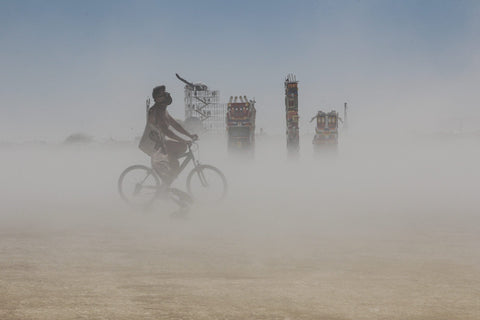
Desert is dictated by the ground, not the mood board. The Black Rock playa is alkaline gypsum and silica dust that irritates skin, so warm clothing for the cold nights, dust masks and goggles are baseline survival kit, not accessories. Everything you wear has to shrug off corrosive dust and then a 40-degree night.
UK mud is the wettest accent. Glastonbury's wettest single day recorded 60.1mm of rain, and 1997 is still the Year of the Mud. Wellingtons are the uniform because they are fully waterproof rubber. The register here is utility layers over waterproof shell, and the trap is thinking the boot solves it, which we come back to below.
Dark festivals are not one look. Wave-Gotik-Treffen in Leipzig, established 1992 and running 18,000 to 20,000 a year, holds gothic, cybergoth, steampunk and rivethead all at once, alongside Victorian and Pagan-market dress. Structured silhouettes, sharp layers, all-black, hardware. Boho is the oldest term, from 19th-century France and the artists living outside convention, crystallised by 1960s counterculture and cemented by Woodstock in 1969, then revived commercially by Coachella. Fringe, lace, natural cloth, draped and flowing.
We cut across all five, and the honest thing is that the accents are real. A print built for a psytrance field reads flat in a dark-festival crowd, and a structured black layer wilts in desert heat. Same brief, different answers.
What actually kills a festival garment?
Dust, mud, friction, and the seams that give first, in that order of quiet damage. The forces are not dramatic, they are repetitive, and repetition is what a weekend has plenty of.
Dust is a chemical attack in the desert, not just grime. The playa's alkalinity is aggressive enough that Burning Man's own guidance tells people to wash gear with a splash of white vinegar in the detergent, the acid cutting the alkaline dust. If a fabric cannot take that treatment, it will not come home clean.
Mud is weight and abrasion combined, working cloth against itself and against your skin with every step, and wet cloth loses its insulating value and pulls heat off you through evaporation, which is the same mechanism as the cold-night risk applied to your whole body. Friction plus moisture is the documented cause of chafing, worst at the armpits, inner thighs, groin and feet, and it gets worse as sweat and rain soften the skin and add slip.
Then the seams. A garment almost never fails in the middle of the cloth. It fails where the cloth is joined, at the stress points, the crotch seam, the underarm, the shoulder, wherever your dancing puts the load. Ripstop weave exists precisely because a tear will spread from a single point, and the grid of reinforcing threads is there to stop the spread, not the initial puncture. When we cut a garment for a field, the seam that takes the dancing load is the one we double, because that is the one that gives first.
What mistakes do we see every year, and what are the boring fixes?
The same handful, every year, and the fixes are dull enough that people skip them, which is exactly why they keep making the mistakes.
Under-packing for the night drop is the top one. Daytime heat convinces people they will not need a warm layer, and then the temperature falls after dark and they are cold for hours. Pack the mid layer you will resent carrying at noon, because you will be grateful for it at three.
Trusting the forecast and skipping rain gear is second. Over a multi-day outdoor event the forecast is unreliable, so a shell goes in the bag regardless of what the sky promised on the drive up.
Open-toed shoes are a genuinely bad idea, and not for looks. In a packed crowd your exposed toes will get stood on, and mud and debris go straight over your feet. Closed-toe, and crucially broken-in, because multi-day festival walking is closer to a marathon spread over two or three extra days, and new shoes mean blisters. Break them in at home first, the most boring advice in this piece and the one that saves your weekend.
Wet boots left on too long is the one nobody thinks of as a mistake until it is a medical problem. Trench foot can set in from cold wet exposure at temperatures up to 16°C, sometimes inside 10 to 14 hours. Wellingtons keep water out, but they do not remove the need for dry-sock discipline. Change socks at least once a day and let your feet air-dry between changes. And do not bring anything that needs its own insurance policy, because jewellery and irreplaceable things get lost or ruined in crowds and mud as a near-certainty, not a risk.
What does longevity really mean after the fortieth wash?
It means the garment comes home dirty and goes back out the next year, which is the only test that counts. A festival garment that survives one weekend looking perfect has not been tested. One that has been through the vinegar wash after the desert, dried out from a soaking in UK mud, worn three days unwashed and then laundered forty times and still holds its seams and its print, that one has earned its place in the bag.
That is the standard we cut to, because a festival is the harshest honest test cloth gets. It is not a controlled wear. It is dust that attacks the fibre, mud that loads the seams, sweat and rain that breed odour and soften skin, and forty washes afterward trying to undo all of it. The garments still standing when the sky goes pale are the ones built for the coming home, not just the going out. Buy for the fortieth wash, not the first night, and expect it to get filthy. Getting filthy and surviving is the point.





1 comment
“I love how your guide captures the essence of festival fashion! It’s packed with vibrant ideas and practical tips that truly unleash creativity. Can’t wait to rock my next festival in style, thanks to Psylo Fashion!”