We have spent since 1999 making clothes for people who will wear them somewhere hard, so a place that turns cloth into a survival decision and forbids anyone selling you a shirt is a place we read very closely.
Who actually wrote the ten principles, and why in 2004?
Larry Harvey wrote them in 2004, and the interesting part is that he was late. Black Rock City had been running since the mid-eighties by then, and the culture that the ten principles describe was already fully formed on the ground. The Regional Network had just been set up and asked for something they could hand to a new event in another country and say, this is how it works. So Harvey did not legislate. He looked at what people were already doing in the dust and wrote it down.
He open-sourced an ethos. The principles were framed as a reflection of a lived thing, not a dictate of behaviour, and that framing matters more than it sounds. Nobody was told to gift, to build their own camp, to pick their own glitter out of the ground afterward. They were already doing it. The document is a description of a habit that had hardened into a set of shared expectations, which is roughly how any real subculture works before someone writes the manifesto.
We make things for scenes that behave the same way. The rules of a festival field or an alternative market are almost never posted anywhere. You learn them by standing in them. Burning Man is rare because someone eventually put its unwritten rules in ink, and once they were in ink you could see exactly what they do to a garment.
Decommodification: why can you not sell the shirt off your back at Black Rock City?
Because it is banned, plainly and structurally. Decommodification, the third principle, asks for social environments that are, in the official text, "unmediated by commercial sponsorships, transactions, or advertising." In practice that means no participant vending. You cannot sell a handmade thing on-site, not even framed as covering your trip costs. Apart from ice and coffee, which the organisation itself sells, there is no commerce inside the event at all.
No commercial logos, no banners, no promotional handouts. Using the event as a backdrop for a product violates the principles, the ticket terms, and the federal permit the whole thing runs under. Black Rock City is treated as a decommodified zone, and it is enforced as one.
Sit with that as someone who prints and sews and sells for a living. We have a shop in the Stables in Camden, we make in Bali, we trade across several countries, and here is a place where every instinct we have professionally is switched off at the gate. You cannot sell the shirt off your back there. Which forces a question we find useful: if the transaction is gone, what is the garment actually for? At Black Rock City the answer is not what a garment is worth. It is what a garment does.
What is the difference between gifting and barter, and why does it change a garment?
Gifting and barter are not the same thing, and Burning Man runs on gifting. The distinction is written into the principle itself. A gift's value is, officially, "unconditional," and it "does not contemplate a return or an exchange for something of equal value." Barter is the opposite. Barter is X for Y, negotiated in the moment, reciprocal, closed. You get your thing, I get mine, we are square.
People assume Black Rock City is a barter economy and it is not, and the community corrects that conflation constantly. A gift carries no obligation to return anything. At most it leaves a memory of having been helped, which might inform future goodwill, but nothing is owed. Nobody is square, because nobody was keeping score.
Change what a garment is for. A coat you barter for is a coat with a price, even if the price is paid in someone else's coat. A coat somebody gifts you in the dust is a coat with a story and no invoice. It becomes a marker of an encounter rather than a transaction. This is the part of the playa that maps most cleanly onto how the best of the alternative scene has always treated clothes: the thing you were handed at a festival by someone who made it means more than the thing you bought, and it means more precisely because no return was expected. Gifting removes the receipt, and once the receipt is gone the object starts carrying the relationship instead of the price.
How does radical self-reliance turn clothes into a survival decision?
It turns them into a survival decision because the desert will hurt you and nothing is sold on-site to fix that. Radical self-reliance, the fourth principle, asks the individual to "discover, exercise and rely on their inner resources." Stripped of the language, it means you are responsible for your own water, shelter, food and body in an extreme environment, and there is no shop to bail you out.
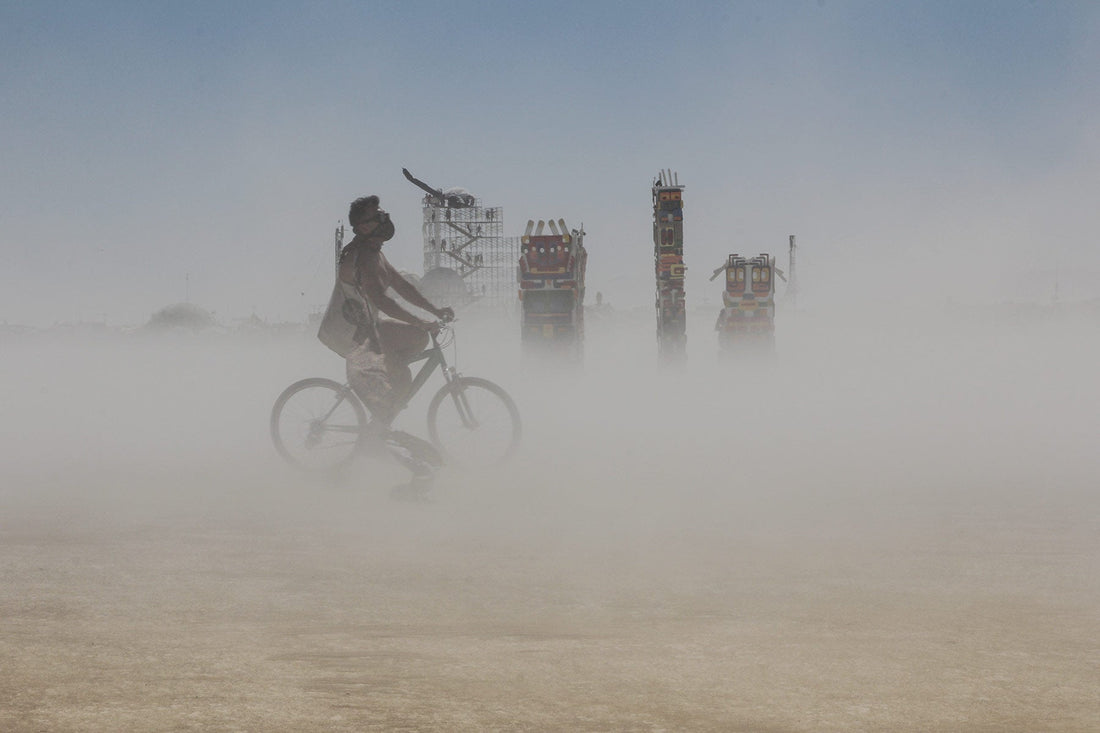
So before a costume is a look, it is protection. The playa runs hot in the day and cold at night, and it throws alkaline dust storms that get into everything. What you put on has to hold up in all three at once. That reorders the whole logic of dressing. You are not choosing an outfit, you are choosing survival kit that also happens to say something about you.
We recognise that order because it is the order we build to. A print is a print, but a strong cut that survives a field, a fabric that behaves in real heat, a layer you can actually rely on when the temperature drops after dark, that is where the garment earns its place. The desert makes the point louder than a festival does, but it is the same point. Self-reliance means the first honest question about anything you wear is whether it will actually do the job, and only the second question is whether it looks good doing it.
Why does a single loose sequin become weeks of someone else's labour?
Because someone has to pick it out of the ground by hand, for weeks, after everyone goes home. Leaving No Trace, the eighth principle, commits the community to "leaving no physical trace" of its activities. On the playa the working term is MOOP, Matter Out Of Place, meaning anything not native to the desert: trash, synthetic debris, hair, string, feathers, glitter, sequins, anything that sheds or blows away.
The enforcement is not a slogan. Every camp does a MOOP sweep of its own site before leaving. Then, after the event, cleanup crews run a forensic sweep of the entire site that lasts weeks, cataloguing and removing what they find down to sequins and cigarette butts. The stakes are structural. Burning Man operates under a land-use contract with the Bureau of Land Management that sets an allowable amount of leftover material per square foot, and the whole operation is measured against it.
This is where dress and ethics collide directly. Loose feathers, glitter, sequins, synthetic fur, wigs, fake eyelashes, face jewels, all of it is a MOOP liability, and specifically because of costume choices. But the community norm is not a ban. It is a responsibility standard: if you cannot secure it so it will not come apart or shed, you are told not to wear it. Non-shedding sequins, feathers fixed down properly, biodegradable glitter, these are the ways people reconcile a costume with the principle.
The reason a loose sequin is frowned on is not that it looks cheap. The objection is entirely functional. That sequin becomes matter someone else has to physically remove from the desert, by hand, for weeks after the party ends. Which is a devastatingly concrete way of making a point that most of clothing culture manages to avoid: a garment does not stop existing when you take it off. As people who cut and sew for a living, we find that the honest version of the sustainability conversation. Not a slogan on a hangtag, but the loose sequin and the person on their knees in the dust three weeks later removing it.
Where does a maker stand in a place that refuses to be sold to?
Uneasily, and usefully. There is a real tension on the playa between the ideals and the reality of who shows up, and it lands hardest on people who make and sell things. The clearest version is the turnkey camp, sometimes called plug and play: a group that arrives to a site already fully built, or pays outside vendors to build it in advance, so the participant meets a ready-made experience that required no labour and no preparation from them.
The criticism is direct. Paying upfront for a prescribed experience that needs no individual effort, in Burning Man's own words, erodes the culture, and the organisation has said plainly that it is not okay to sell people the Burning Man experience as a vacation package. It reads as a violation of self-reliance and participation, because the experience was bought rather than built, and in its most expensive forms it violates radical inclusion too, because a velvet rope introduces exclusivity into a culture built on the opposite. One camp reportedly sold spots for up to a hundred thousand dollars with luxury accommodation and chef-prepared meals. Burning Man Project has said it is committed to ceasing the plug and play culture entirely.
So where does a maker stand. Honestly, with a foot on each side of the line. We sell clothes, and the whole event is built to refuse selling. But the objection at Black Rock City has never been to the maker who made the thing. It is to the commodity that arrives finished, unearned, sold as an experience. The DIY dress culture on the playa is the answer to its own critique: hand-sewn costumes, repurposed vintage, garments modified or altered by the wearer rather than bought ready-made, choices built around a personal story, tarot, the elements, the occult, heritage, whatever the individual carries. Radical self-expression protects the right to make it, and it says no one other than the wearer gets to determine its content. The maker who belongs there is the one whose work someone finishes, alters and lives in, not the one who ships a completed lifestyle to the gate.
What is the real argument these principles make about what we put on our bodies?
The argument is that a garment is never only a look, and the desert is just honest enough to prove it. Read the principles together and they keep landing on the same body. Decommodification takes away the price, so the garment has to carry meaning instead. Gifting takes away the receipt, so it carries a relationship. Self-reliance makes it survival kit before it is style. Leave No Trace makes it accountable, all the way down to a single shed sequin and the hands that remove it.
Strip all of that back and what is left is a claim most of clothing culture is built to help us forget. What you put on your body is a decision with consequences: for the person who made it, for the person who might be gifted it, for the ground it eventually sheds onto. Black Rock City did not invent that claim. It just built an event where you cannot buy your way out of it, and then, in 2004, wrote the whole thing down.