We have been printing UV-reactive graphics on black cloth since before most people knew what a blacklight cannon did to a garment, so this is a scene we have kitted out from the inside, not one we are describing from the edge of it.
Where did psytrance actually come from?
It came from a beach, some borrowed hardware, and a refusal to separate the machine from the spirit. Goa, on India's west coast, had been a travellers' hub since the mid-1960s. By the late 1980s the free parties on the sand at Bamboo Forest in South Anjuna and Disco Valley in Vagator were running on cassette imports of European acid house and techno, mixed live and layered over Indian ragas and ethnic percussion. That fusion crystallised into Goa trance in the early 1990s, and the widely-agreed first golden age ran 1994 to 1997.
The sound had a fingerprint you can still read today. Tracks ran eight to twelve minutes, sat somewhere between 130 and 150 BPM, and were built on a drone-like bassline, a thick sub-bass kick, and that squelchy sawtooth lead pushed through a resonant filter. The gear was hardware: Roland TB-303s, Juno-60s and 106s, the SH-101, a Korg MS-10, a Novation Bass-Station, and a rack of samplers dropping sci-fi film dialogue about psychedelics and outer space between the drops.
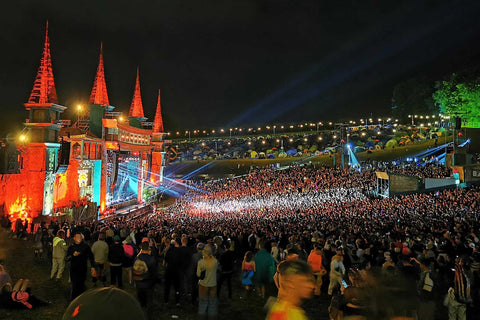
Paul Oakenfold put it on international radar in 1994 with his Goa Mix on Radio 1 and his Perfecto label. When digital production replaced the hardware-only workflow at the end of the 1990s, Goa trance became psytrance, and a 1999 shot of Detroit-techno influence pushed it harder and more industrial. Israel turned into a production powerhouse around then, with Astral Projection and Infected Mushroom leading it, and the scene spread out into Germany, Australia, Japan, South Africa and beyond. That lineage is what grew Boom Festival in Portugal, VooV in Germany, and Rainbow Serpent and Earthcore in Australia.
How do you read a psytrance festival by tempo?
You read the room by BPM and by where the sun is, because the music is arranged around the clock. Full-on is the peak-time engine, roughly 140 to 148, melodic and punchy, and it splits into a bolder darker version for the night and a lighter, uplifting one for the morning when people are still standing and the sky is going pink.
Forest psy grew out of dark psy but pulled it back toward the organic. It keeps the intensity but builds it from earthy textures and tribal percussion, soundscapes made to feel alive, closer in spirit to the warmth of old Goa trance. Dark psytrance is the cold, heavy, horror-atmosphere lane, dismal textures over heavy basslines aimed at going deep through the night, and it firmed up as its own recognisable style after 2003, strongest in Germany and Russia. Hi-tech takes the synthetic edge and runs it flat out, one of the fastest strains in the whole family, sitting anywhere from 170 up toward 230.
Then there is the tent where the night cools off. Psybient, or psychill, fuses the scene with ambient, dub and world music, well below dancefloor tempo, textured and slow. Progressive psytrance, which came up in the mid-2000s, lives in a similar space at indoor events and chill zones, deep and atmospheric with house and techno bones. This is where the floor exhales, where people sit down for the first time in hours and let the sunrise do its work.
What does the tribe actually mean when it says tribe?
It means a movement you join by showing up and taking part, not a status you buy. The scene has self-identified as tribal for decades, and the ethnographic work on it, most notably Graham St John's Global Tribe, frames the dancefloor itself as the ritual space, a ceremony whose whole point is harmony among the people on it rather than a performance to watch.
The tribe folds spirituality and technology into one continuous thing rather than opposites. Psychedelics, environmentalism, New Age practice and the digital tools that make the music are treated as a single activity, the techno-tribe framing where producing a track and running a ceremony are the same craft. On the floor that plays out as ego dissolution: dancing is intensely individual, loose, everyone in their own little world with their own patch of space, and yet the whole thing is experienced as collective. Unity comes from the shared music and the freedom to move without being judged, not from choreography or matching anyone.
Underneath it runs an anti-hierarchical ethos the scene guards hard, tolerance, playfulness, a resistance to VIP-tiered commercial festival structures, and a liminality that scholars describe as the defining feature of the event itself, a bounded stretch of time and space where ordinary social identities loosen off. When we make for this crowd we are making for people who dress themselves, not for people who want a uniform, and that changes the whole brief.
What are the two ways people dress a psytrance floor?
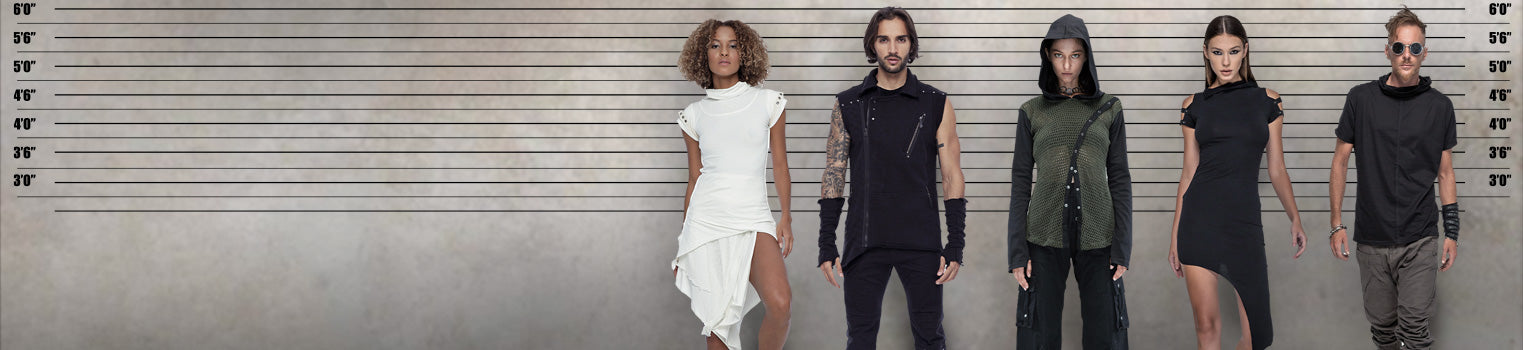
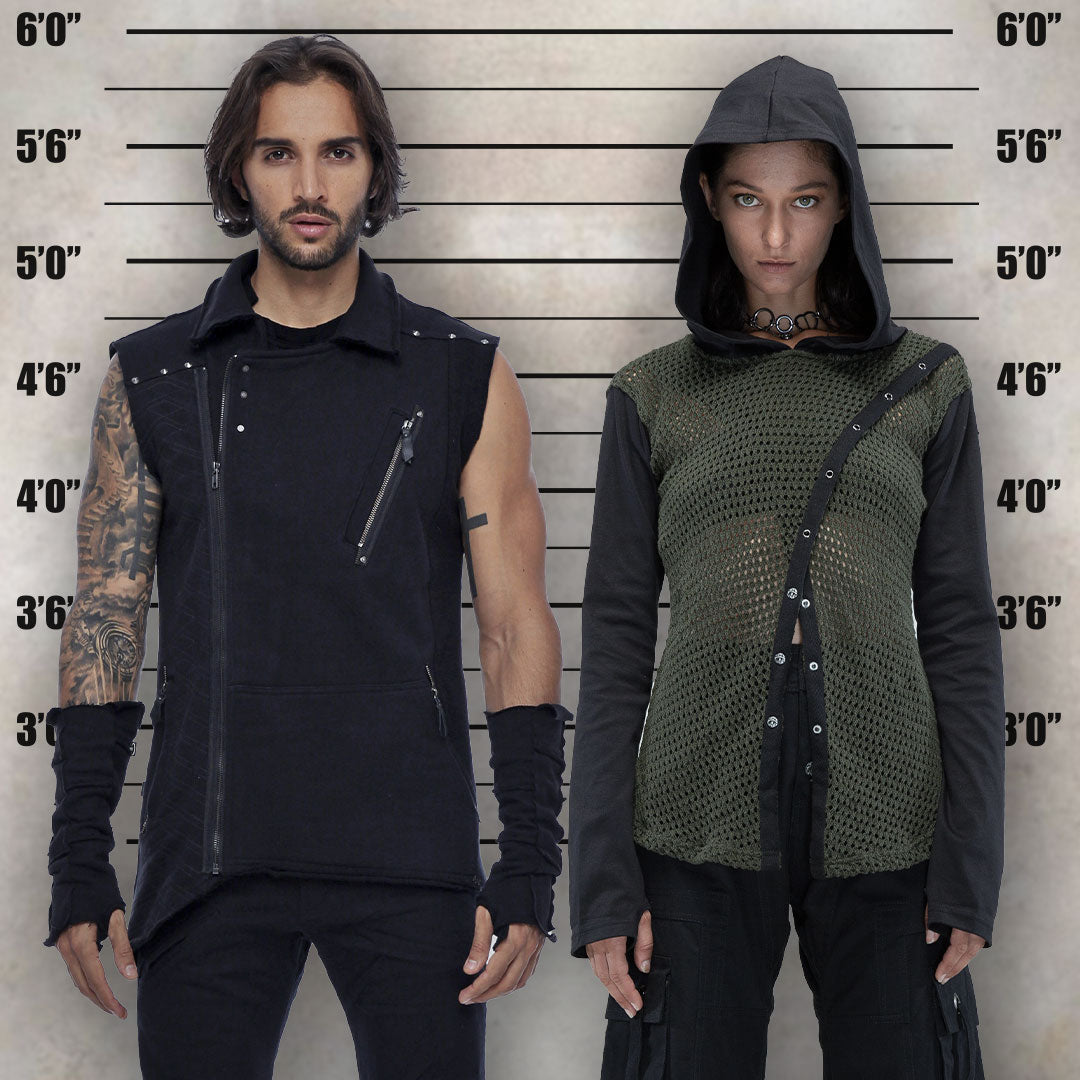
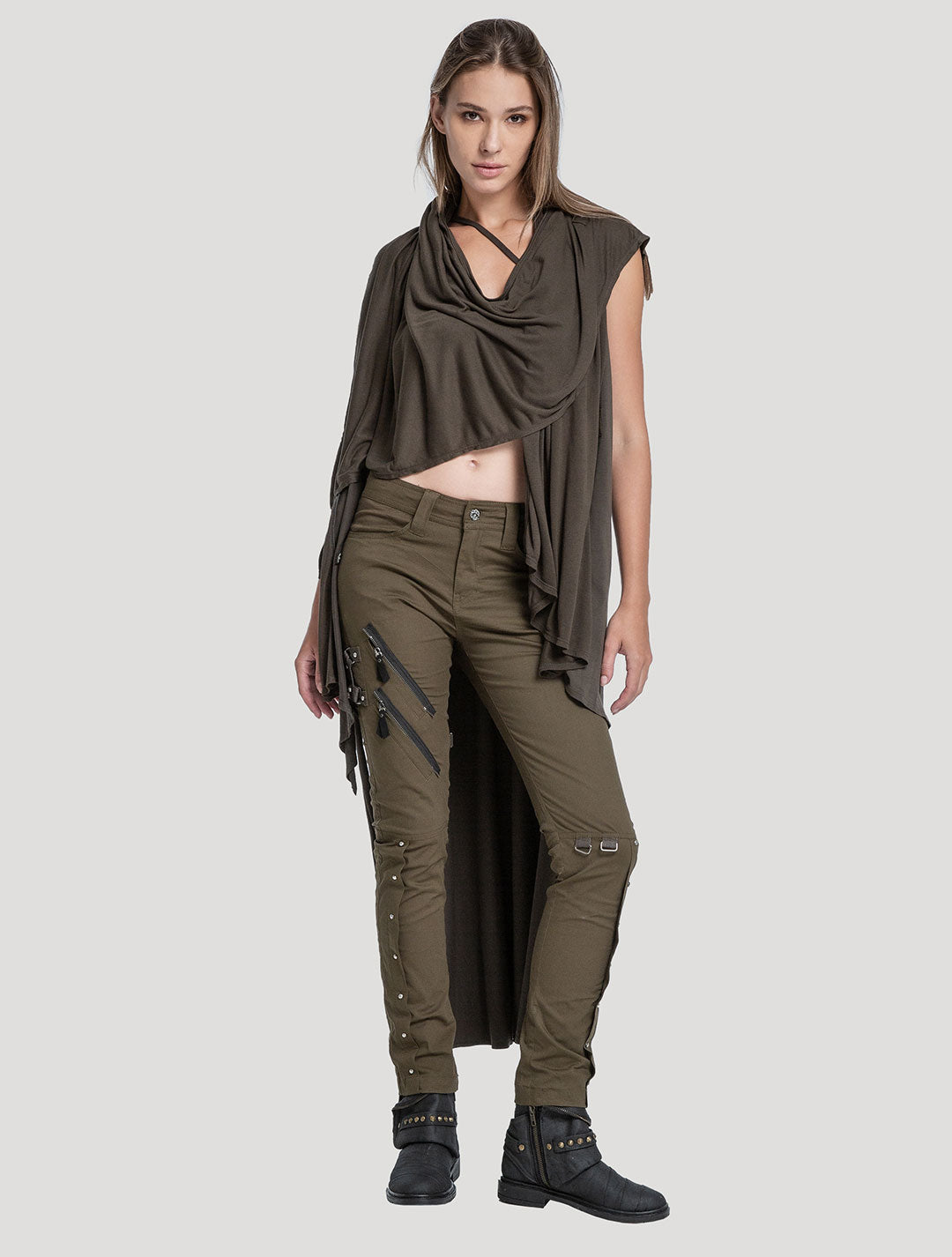
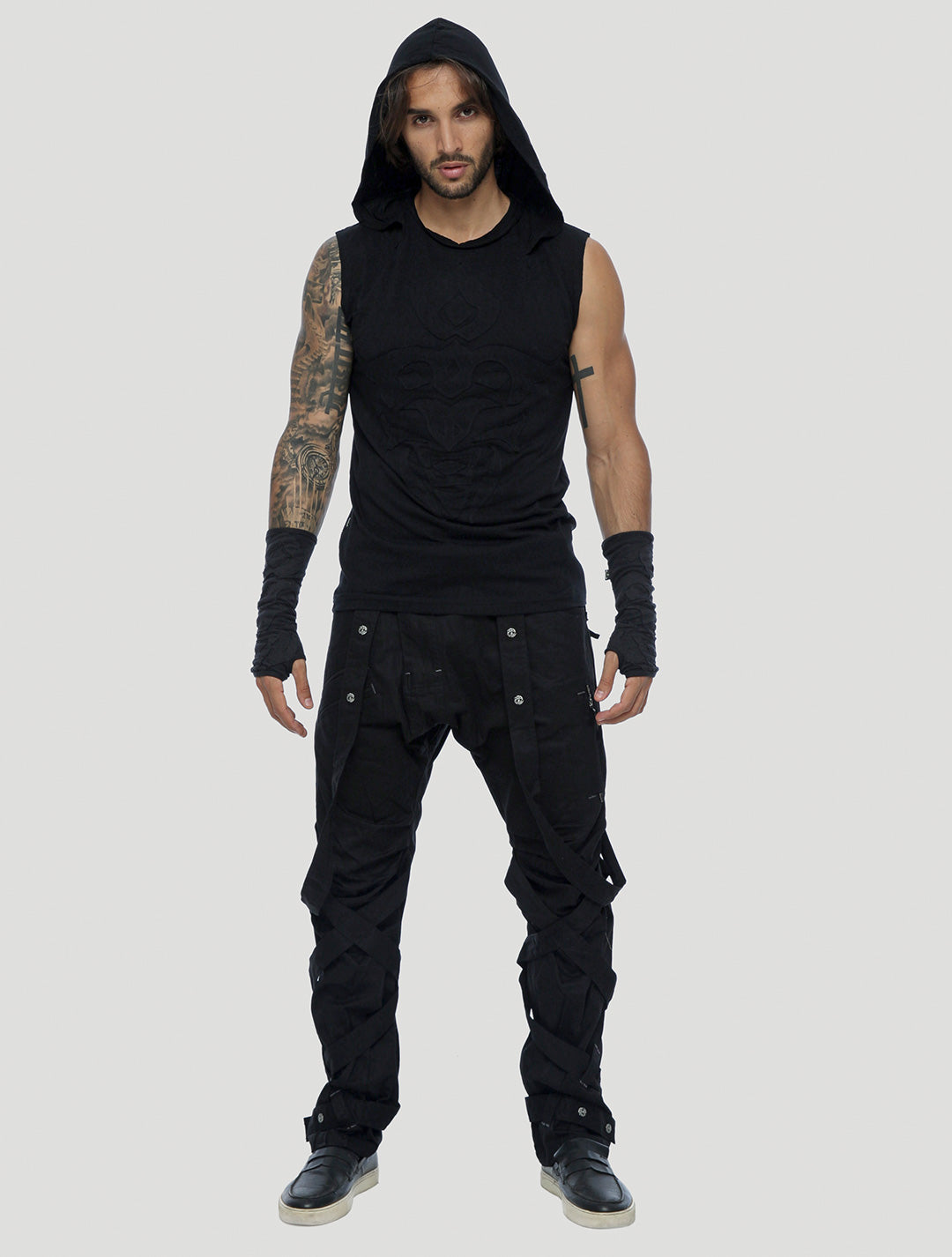
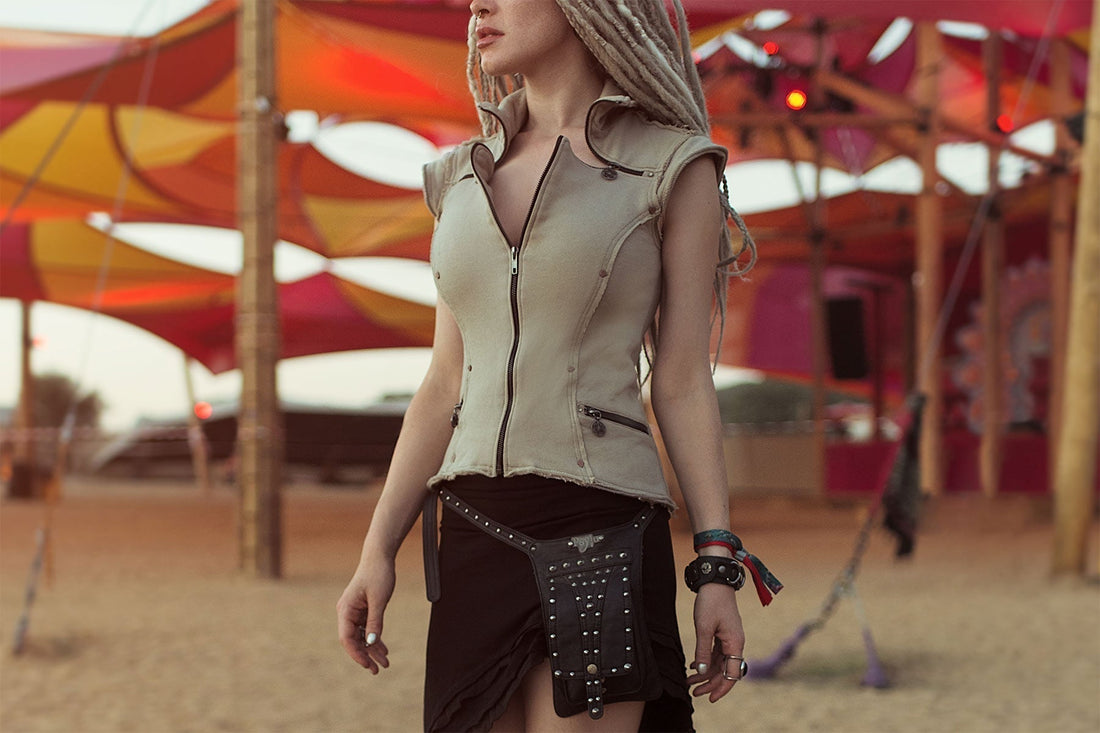
There are two lanes, and most people move between them across a weekend. The first is the black-and-UV lane: a dark base garment, usually black, carrying a screen-printed pattern that sits muted or nearly invisible in daylight and then activates under the blacklight cannons at night, reading as a glowing, three-dimensional graphic. The second is the earth-toned ethno lane, natural fibres in muted and earthy palettes, drapey loose silhouettes closer to bohemian and tribal dress than to rave-specific UV gear.
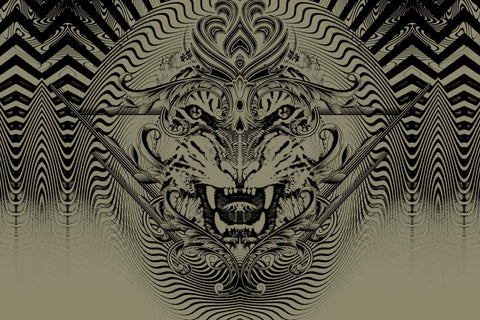
The iconography across both is consistent because it comes from the same visionary-art lineage as the music: sacred geometry and mandalas, fractals, eyes, serpents, mushrooms, cosmic and space imagery. Where the crossover happens is in the ethno lane's technique. The hand-dyeing and the ikat weaving that show up on these festival silhouettes come out of indigenous textile craft, and ikat we know well, because endek is a working part of how we cut and print in Bali. That is the honest tie between what the scene wears and what we make, an ethnic-print, layered, draped register that we have been building in our Ethno flavour for a long time.
Which print hides in daylight, and which fabric survives the night?
The print that hides is the UV one, and it hides on purpose. The glowing night graphics are screen-printed or sublimation-printed onto synthetic cloth, lycra and spandex blends and satin, chosen specifically because the ink reads as ordinary line-work by day and lights up under blacklight after dark. It is a two-state garment. You wear the same top at four in the afternoon and at two in the morning and it is doing two completely different jobs.
The fabric that survives the night is the non-UV one, and here the choice runs the other way. The ethno-lane garments favour natural and natural-blend fibres, heavy cotton and bamboo blends, picked for breathability and for lasting through long sweat-heavy sessions in the open air. We have watched enough of our own cloth come off a psytrance field to know which prints hold and which cotton keeps its shape after a night on a floor, and that knowledge is quiet but it is real. Layering is a design principle rather than a look here, tunics and wraps and skirts built to come on and off across the day-night cycle as the temperature drops and the vibe shifts, the same base outfit designed to transform through the night. That is the same thinking that has run through our Punk and Ethno work since 1999, cut for movement and made to take a beating.
Why are a canopy, a booth wrap and a trouser cut from the same grammar?
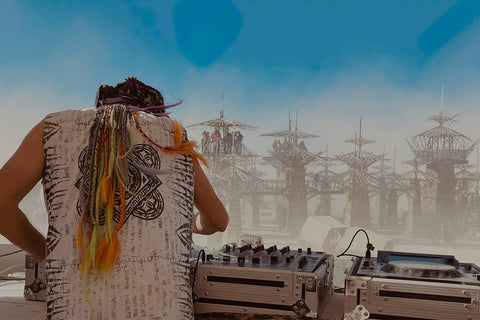
Because on a psytrance floor the clothing and the room are built from one design system, not two. The UV-reactive, sacred-geometry, fractal vocabulary that goes onto a garment is the same vocabulary applied at full scale to the environment: backdrop tapestries, ceiling canopies, DJ-booth wraps, all using the same core technique, blacklight-reactive print on lycra and satin. The dancer and the space glow with the same ink under the same cannons.
That shared grammar is not a marketing conceit, it comes straight out of the scene's DIY origins. The fashion started at underground gatherings where people made their own clothes, hand-painted their own jackets, and traded handmade garments as psychedelic art in its own right, not merchandise bought to prove you were there. When the same person who paints a jacket also paints the backdrop, the trouser and the canopy end up speaking the same language because a single hand made both.
So when you stand on the floor at Boom and the whole tent lights up at once, the geometry on the ceiling, the fractal running down someone's trouser leg, the mandala wrapping the booth, you are inside one continuous surface that only fully exists after dark. Turn the blacklight off and half of it disappears back into black cloth and plain line-work, waiting for the night to switch it on again. That is the trick the scene built for itself, a whole visual world that lives only at night, printed on a floor full of people who made most of it by hand.