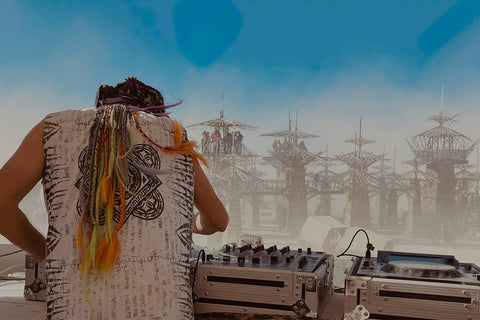
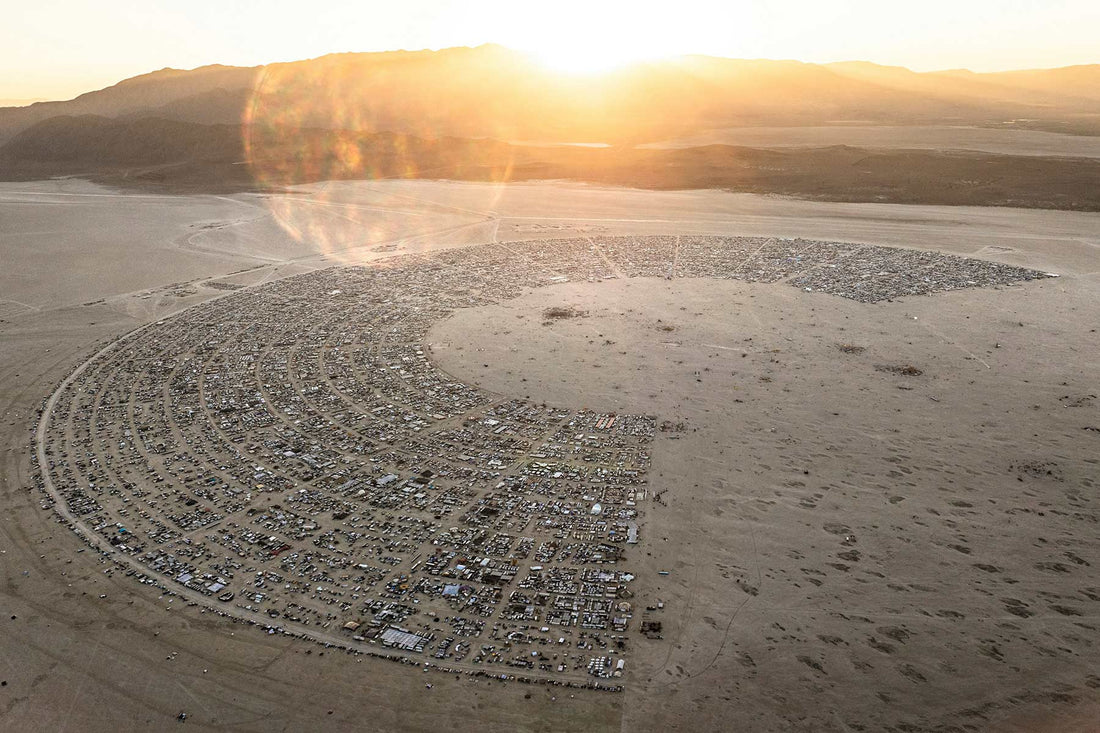
We have kitted people out for festival fields since 1999, and the Black Rock desert is the one that argues back hardest. Here is how we think about dressing for it, from the cut up.
Why is the playa harder on clothing than any other festival ground?
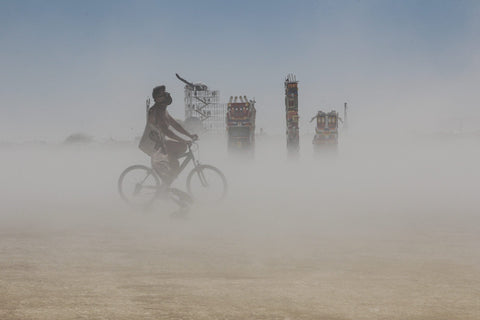
Because the ground itself is not neutral. Black Rock City sits on a dry lakebed at around 4,000 feet, and the dust it kicks up is alkaline. That is not a poetic way of saying dirty. It rusts metal fast, and on skin it behaves like a mild chemical burn, drying and cracking the surface into what burners call playa foot, which can last weeks after you leave. People carry a diluted vinegar solution, roughly one part vinegar to three parts water, to neutralise it and clean the dust out of the cracks.
So before you think about a print, a cut, or a colour, understand what you are dressing against. Every garment that goes out there gets coated. White goes grey by lunch. Metal fastenings corrode. Anything with an open weave lets the dust straight through to your skin. When we cut and print in Bali, we are used to fabric behaving well in heat and humidity. The playa is the opposite brief, hot and bone dry, and it changes what a good garment even means out there.
What is the real design brief on the playa?
The 24-hour temperature swing. That is the whole thing. Daytime routinely climbs past 100 degrees Fahrenheit with almost no humidity, and at that elevation the sun burns you faster and harder. Then the sun drops and the temperature can fall around 50 degrees, into the 40s Fahrenheit overnight. Most people need about a day just to physically adjust to that gap.
You cannot solve a 50-degree swing by packing a wardrobe and changing four times. Sand gets into everything, tents are chaos, and you are often nowhere near your camp when the light goes. So the answer most burners land on, and the one we build to, is a single durable base worn all day, with a sun layer added for the midday peak and a warm layer thrown over the top once it turns cold at night. One base, three states. The base does the work. The layers do the weather.
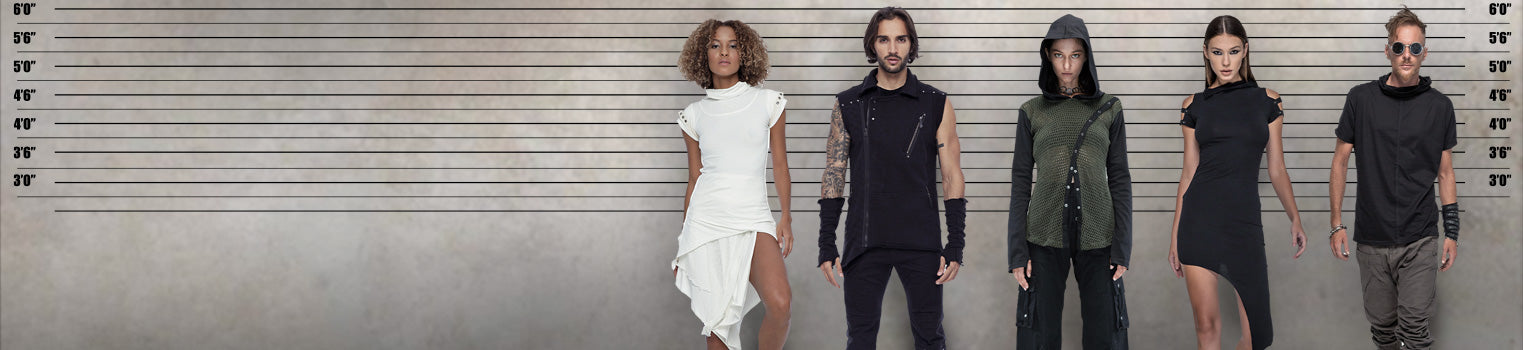
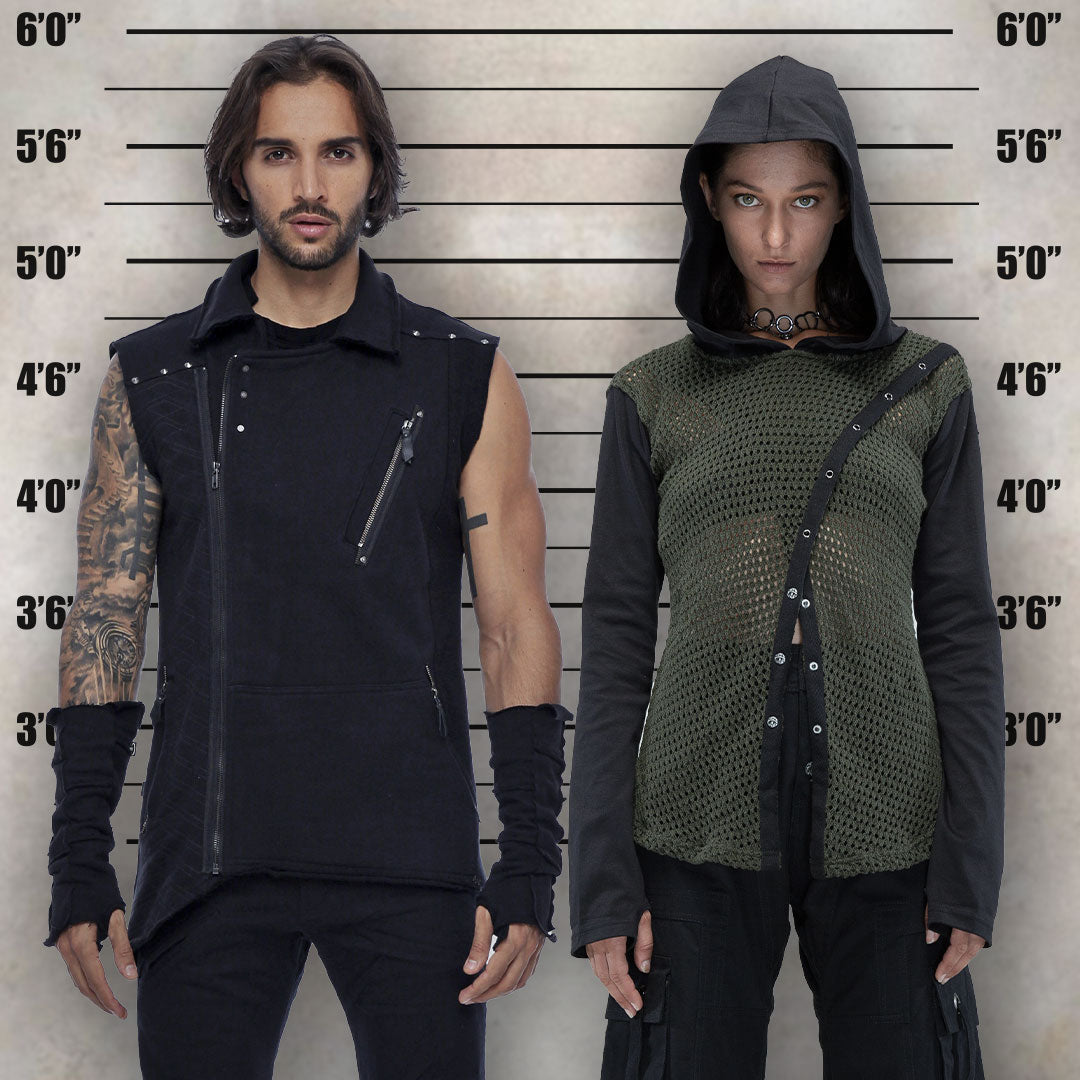
That is why we tend toward one strong garment as the anchor rather than a full costume, a bodysuit, a jumpsuit, a heavy tunic, something with a real cut that reads all day and takes an overshirt or a jacket without fighting it. It is the difference in our own lines between a punk-leaning hard cut in all-black that carries dust honestly and a draped ethno layer that moves in heat. Either can be the base. Neither works if it only looks right for one hour of the day.
Which kit is non-negotiable, and can you style your way out of it?
No, you cannot, and that is the first thing to make peace with. Some gear is not an aesthetic decision.
Goggles that seal against dust, and a proper dust mask or particle respirator, not a bandana. Dust storms come up suddenly. Wind around 15 mph is already enough to raise dust and cut your visibility, and gusts have been reported over 75 mph. A whiteout can drop visibility to under a foot. The official advice if one catches you with no shelter is to sit down, turn your back to the wind, and cover your face. A reusable mask with a filter genuinely outperforms fabric tied over your nose when it gets serious.
Then the daylight kit. Sunblock reapplied through the day, sunglasses, a wide-brimmed hat, ideally with a chinstrap because the wind will take it. Lip balm and lotion, because the dry air cracks you. And closed, sturdy, broken-in boots, never new out of the box, with spare socks, because dust works through fabric fast and open shoes put your skin straight onto the alkaline ground. After dark, lights on your body, a headlamp or flashlight with spare batteries. Riding or walking with no light is called unsafe outright, and a weak glow bracelet does not count. EL wire wrapped around a base is cheap and flexible but dim, so most people back it up with brighter LED strip.
The point of naming all this first is simple. You build the expressive part around this kit, not instead of it. The mask and the goggles are coming with you regardless, so design as if they are part of the outfit, because out there they are.
What do we actually cut for dust and movement, and why does it read right?
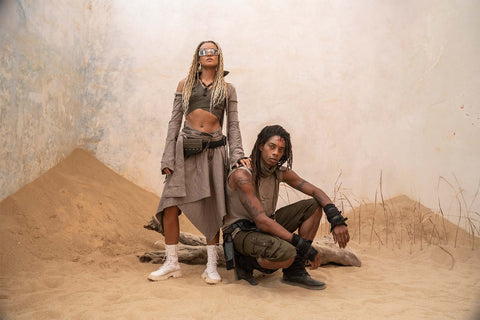
We cut for coverage that still breathes, and for movement that does not snag. Long sleeves and long legs in a light, closely enough woven cloth keep the sun and the worst of the dust off your skin while still letting heat out. That reads better on the playa than skin does, oddly, because a body that is covered, layered, and clearly built for the place looks like it belongs there. A thin exposed outfit just looks like someone who has not been out overnight yet.
Draped and layered shapes work with the swing rather than against it. A base that takes an overshirt cleanly, sleeves you can push up at midday and pull down at dusk, a cut that lets you cycle, climb into an art car, and dance for hours without riding up. We favour strong prints and eclectic pattern here for a real reason beyond taste, dust flattens a plain garment into grey within hours, and a bold graphic or a tribal-leaning print holds its identity through the coating far better than a delicate one does.
Colour is a quiet decision too. Deep tones and all-black carry the dust as patina instead of showing it as stain. That is why so much of what survives visually out there sits in the darkwave and post-apocalyptic register, hard cuts, utility layering, worked-in surfaces. It is not a look chasing grit. It is a look that dust improves rather than ruins.
Is MOOP a killjoy, or a design constraint you can work inside?
It is a constraint, and a good one. MOOP means Matter Out Of Place, Burning Man's leave-no-trace standard, and it is where a lot of costume ambition falls apart. Glitter is not allowed in Black Rock City at all, because it scatters and never comes back. Feathers, sequins, rhinestones, and synthetic wigs are not blanket-banned, but they are the named repeat offenders, and the reason is mechanical rather than moral.
Feathers dry out and go brittle in the low humidity, so the glue holding them fails and they shed one by one across the ground. The responsibility for containing that sits with the wearer, not with the material. Which is the whole solution right there. If you want feathers or sequins in an outfit, the fix is attachment, stitch and anchor them so securely that nothing can work loose, or leave them at home.
We think this way about construction anyway. A trim that sheds is a trim that was badly attached. Sew it in properly, and the same feather that becomes MOOP on a hot-glued costume stays exactly where it belongs. The constraint does not kill the maximalism, it just demands the maximalism be built to hold.
Where does playa dressing go wrong most often?
Three ways, over and over. Heels, or any stiletto-style footwear, on a loose, uneven, dust-covered surface, which is called out as a mistake for the obvious reason that you will roll an ankle and expose your skin to the ground. White cotton, or anything pristine, which the alkaline dust coats and stains within hours, so it looks tired by lunch and stays tired. And the costume that was built for one photograph.
That last one is the real trap. A concept costume that transforms you into something for a single moment tends to die by nightfall, because it was never designed to cross the day. It looked complete at 4pm and then the sun dropped 50 degrees, the wind came up, and there was nowhere to add a warm layer without wrecking the silhouette. The people still moving at 3am are almost never in the most elaborate thing on the playa. They are in a strong durable base that took a jacket, kept the dust off, and let them keep going.
The point is not to look practical. It is to still be standing when the light drops.
That is the whole test, and it flips the usual thinking. Function is not the opposite of expression out here. Function is what lets the expression last more than an hour. The outfit that survives scorching day, freezing night, a sudden whiteout, and long hours of movement is the one that still gets to say something at dawn, when almost everyone in the impractical outfit has gone back to camp cold.
So build the base to hold. Layer the weather over it. Attach anything that could shed like you mean it. Keep the mask and the lights on you and treat them as part of the look. Do all that, and the desert stops being the enemy of what you are wearing and becomes the thing that makes it read. Dust patinas the black, the print holds through the grey, and the person still dancing when the sky goes pale is the one who dressed for all three states of the day instead of just the good one.